Tag: pure data

  • Reykjavík Sunburn

    This is the most recent framework that builds on previously proven techniques of Latent Jamming solidified into abstractions for easy set up. It’s also the first framework to use more than two models in parallel.

    In Reykjavík Sunburn, four different neural audio models are used: each two RAVE and vschaos2 models.

    • Black Latents: a RAVE V2 model trained on the Black Plastics series – 28 tracks/ 3h of drum- and percussion-heavy electronic music. The resulting model generates mainly percussive output with rough textures and a generally high grittiness. In the composition, this model is used as a leading asset to generate the rhythmic baseline and general percussive structure. 
    • Nobsparse: a RAVE V2 model trained on a hybrid dataset of Tech House and sonically sparse Drum & Bass (about 4h of audio material). The model’s characteristics are relatively clear, sterile, and lightweight sounds, harmonic textures, and an isolated but dominant low end. Depending on the process development during the recording session, this model serves as a secondary texture generator but can also replace Black Latent’s role in the composition. 
    • VSC2_Nobsparse: this vschaos2 model has been trained on the same dataset as the Nobsparse RAVE model. In the composition, this model is used to generate interchanging pads and drone-like noise textures for transitions or simply to enrich an ongoing section of the recording with a harmonic layer.
    • VSC2_Martha2023: being the only model trained on voice data, courtesy of my daughter, this model adds a layer of rhythmical, pseudo-vocal sound on top of the otherwise „instrumental“ generations of the three other models. 

    Together, these four models are responsible for 100% of the audio information created. No additional synthesizing techniques or sound sources have been used. 

    Output examples

    Reykjavík Sunburn (Take 1 Redux) received recognition at the AI Song Contest 2025 where it was selected to the finalist shortlist of 10 out of >150 submissions.

    A release with multiple recorded versions from the framework is currently in the making.

  • Latent Russando

    Latent Russando is a semi-generative compositional framework written in Pure Data dedicated to exploring musical qualities in working with generative neural nets for audio, conceived both as hybrid instruments and as autonomous actors.

    Practices from generative music and algorithmic composition are used as mediators between human performer and the generative abilities of the neural nets, displacing and circumventing concepts of authorship and genius by empowering multiple independent agents in an improvisation-driven, co-creative process.

    The work is based on Russando. Serenade for six German Sirens, op. 43 by Hallgrímur Vilhjálmsson, a heteronym of conceptual artist Georg Joachim Schmitt. The original piece was composed in 2008 and premiered in the context of the (also fictional) art exhibition cologne contemporary — international art biennale 08 at Asbach-Uralt Werke in Rüdesheim. It is a three-part composition of approx. 33 minutes in length, in which six German emergency and police sirens are alternately sounded together or alone. In consultation with the creator, I trained models based on two neural net architectures (RAVE, vschaos2, both courtesy of IRCAM, Paris) on the original piece.

    Output examples

    For Soundcinema Düsseldorf 2025, I expanded the Latent Russando framework into a multichannel version employing 8 models with their outputs distributed over 7 channels. At the festival, I presented Nebuloso that stands exemplary for a potentially infinite number of musical works that can be generated with the framework; it is the output of a joint creative act of human and artificial agents. With this, both the conceptual genesis of Russando with its distributed or fictionalized authorship is reflected as well as the interplay of control and autonomy in a process that deflects claims of unique authorship and concepts of solitary genius.

  • Neural network bending in Pure Data

    The practice of bending systems, that is: modifying or disrupting their intended functions, has been a recurring aspect of artistic practice across different cultural contexts. More recently, the bending of neural networks has become a point of interest for researchers and practitioners, driven partly by the desire to expand the models’ generative capabilities through alterations to their underlying structures for processing and reproducing information.

    “One common criticism of using deep generative models in an artistic and creative context, is that they can only reproduce samples that fit the distribution of samples in the training set. However, by introducing deterministic controlled filters into the computation graph during inference, these models can be used to produce a large array of novel results.”

    Broad et. al. “Network Bending: Expressive Manipulation of Generative Models in Multiple Domains” https://www.mdpi.com/1421002

    A few months back I came across Błażej Kotowski’s fork of nn~. It adds a new functionality to the nn~ object that exposes neural net layers along with their weights and biases for compatible model architectures (e.g. RAVE, vschaos2, MSPrior or AFTER). It also allows you to modify weights and biases and push them back into the respective layer. That means we can hack into these models and do some network bending experimentation in real time now, purposefully altering, partly disrupting the capabilities of the model both in terms of processing and creating audio information.

    Bender abstraction for Pure Data

    Inspired by Błażej’s video, i’ve created an abstraction in Pure Data that can modify the neural net’s data in various ways, such as off-setting, randomizing or inverting values. That component is called Bender and is available on Github.

    Since the changes can have a dramatic effect on the sound, I’ve added a method that lets you control the percentage of data points affected when applying adjustments. This makes the results much less extreme, allowing you to bend your neural network in a more subtle way.

    You can select the desired percentage by moving the slider to a position between 0 and 100%. The number of data points is then calculated and evenly distributed within the selected layer. Any adjustments made using the sliders next to the array will only affect these specific data points, not the entire array.

    Limitations

    The number of data points per layer can range from a few thousand to millions, depending on the model’s architecture and training setup. This can impact the real-time performance of network bending, especially based on your workstation’s configuration. I haven’t found a practical solution for this issue yet, but it might be addressed in the future.

  • Sinusoidal Run Rhythm: implementation in Pure Data

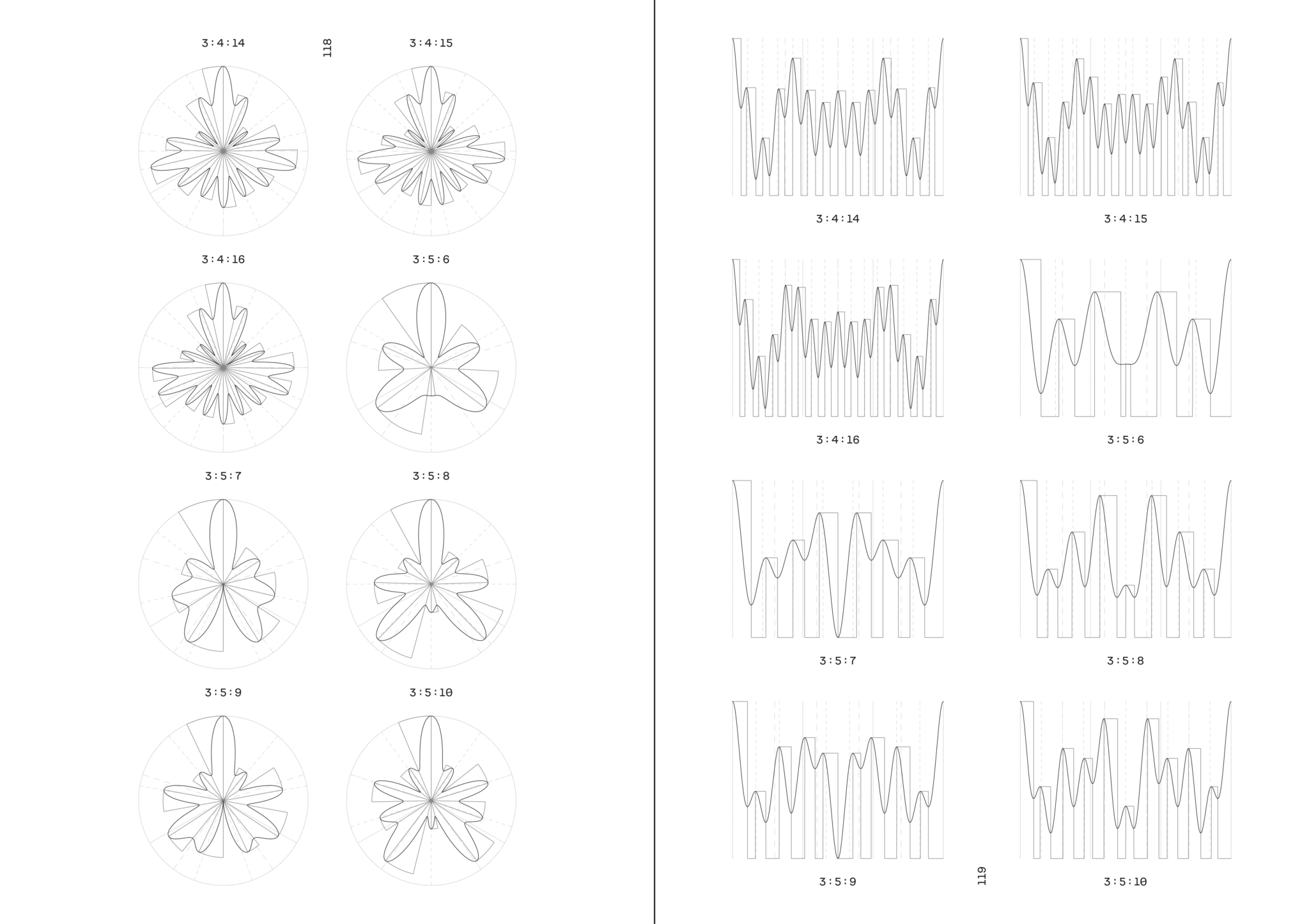
    In his research and book on Sinusoidal Run Rhythm, Steffen Krebber describes a way of generating non-discrete rhythmical patterns by adding up in-phase cosine functions in integer ratios.

    Source: https://steffenkrebber.de/research/sinusoidal-run-rhythm

    Sinusoidal Run Rhythm comes with shifts in timing relative to discrete rhythmic or polyrhythmic patterns and also adds volume weighting.

    This temporal shifting is significant because it illustrates how rhythms generated from wave interference behave differently from manually constructed or performed rhythms. These shifts and volume variations introduce a nuanced, fluid quality to the rhythm that is not easily replicable through traditional musical notation or performance. Therefore, Krebber considers Sinusoidal Run Rhythm to allow a subobjective perspective on rhythmic patterns.

    “‘sinusoidal run rhythm’ proposes a definition of rhythm as a wave. It does not conceive of time as discrete subdivisions, but makes it continuously quantifiable. Concurrently, through the aesthetics of wave additions, it does not present physicality as a merely subjective concept and thus liberates it from mystification.”

    Steffen Krebber (2024)

    In electronic music, similar kinds of rhythmic patterns often appear in low frequency oscillator based modulations e.g. in sound synthesis or filtering.

    Pure Data implementation

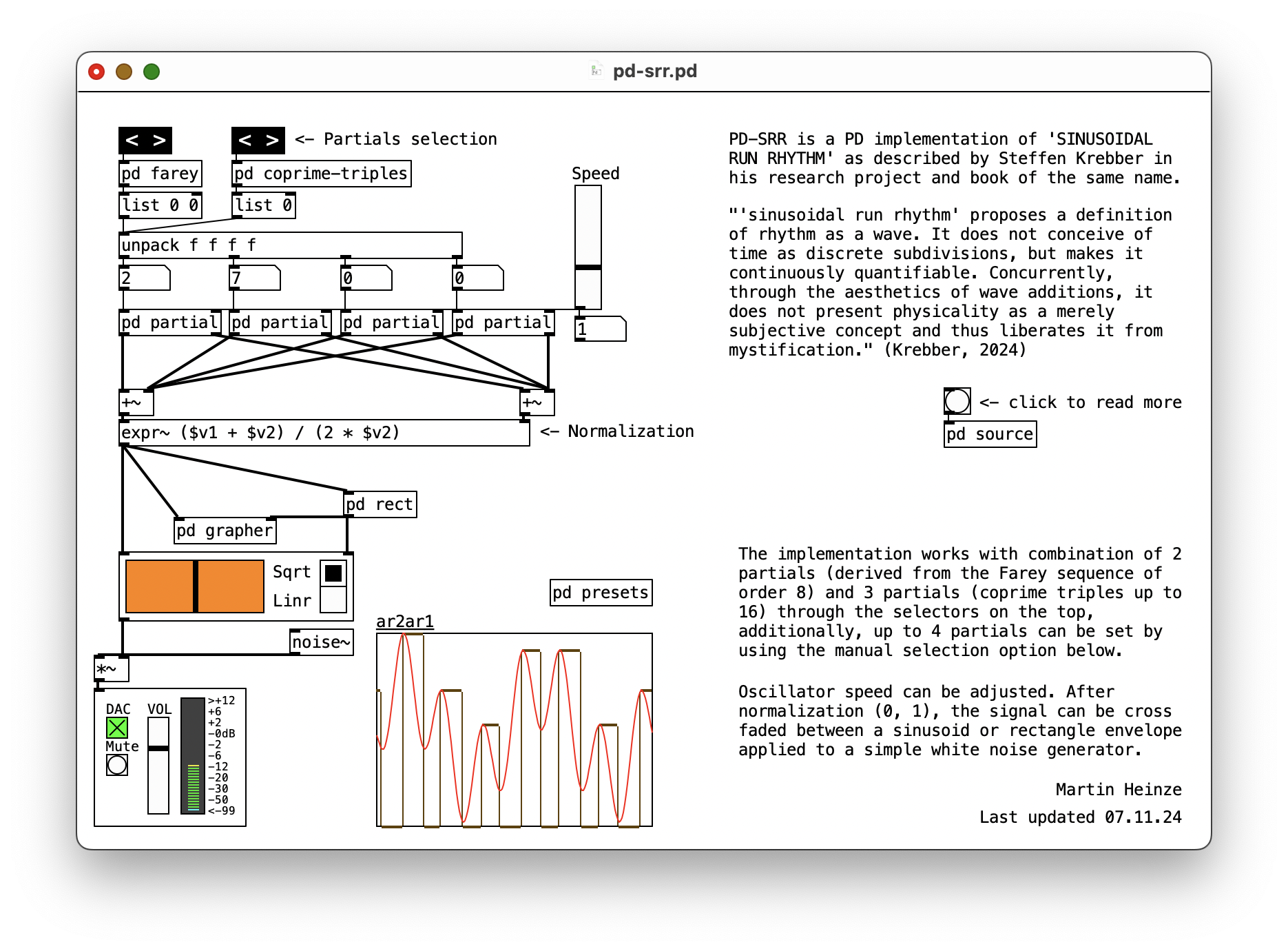
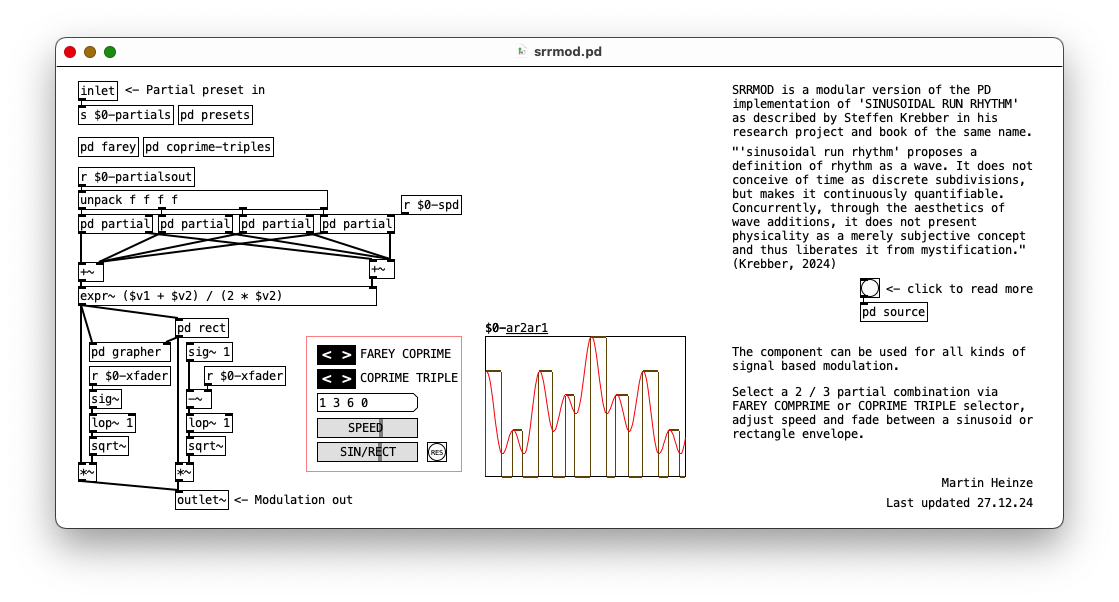
    PD-SRR is an implementation of Krebber’s concept of Sinusoidal Run Rhythm in Pure Data. It comes as both a standalone (pd-srr.pd) and modular (srrmod.pd) version, the latter for use in compositions. You can find it on GitHub.

    The standalone implementation works with Sinusoidal Run Rhythm applied to the amplitude modulation of a white noise generator similar to the web based application Steffen Krebber presents on his website.

    As suggested by Krebber, the implementation works with combinations of 2 partials (derived from the Farey sequence of order 8) and 3 partials (coprime triples up to 16) through dedicated selectors. For further experimentation, up to 4 partials can be set by using the manual selection option.

    The modular version of the implementation allows setting the partial combination from the calling patch and outputs the result through its outlet for use in signal modulation.

    In the following video, I’m showing three scenarios where srrmod.pd is used to modulate both sound synthesis parameters as well as a filter in a compact setup.

    It should be interesting to expand the concept of Sinusoidal Run Rhythm to larger compositions both incorporating it as rhythmical baseline for sound generators and modulators alike but also experiment with an application on a compositional level.

    Thanks to Steffen, whom I had the pleasure to first meet and talk to at the ArtSearch 2024 symposium at ligeti zentrum in Hamburg recently. His presentation on Sinusoidal Run Rhythm sparked quite a few new ideas on my end.

  • Risset rhythm: implementation in Pure Data

    Jean-Claude Risset described the auditory illusion of an “eternal accelerando”, where, similar to Shepard tones for pitch, a rhythm can be structured and played back in a way that creates the perception of constant acceleration.

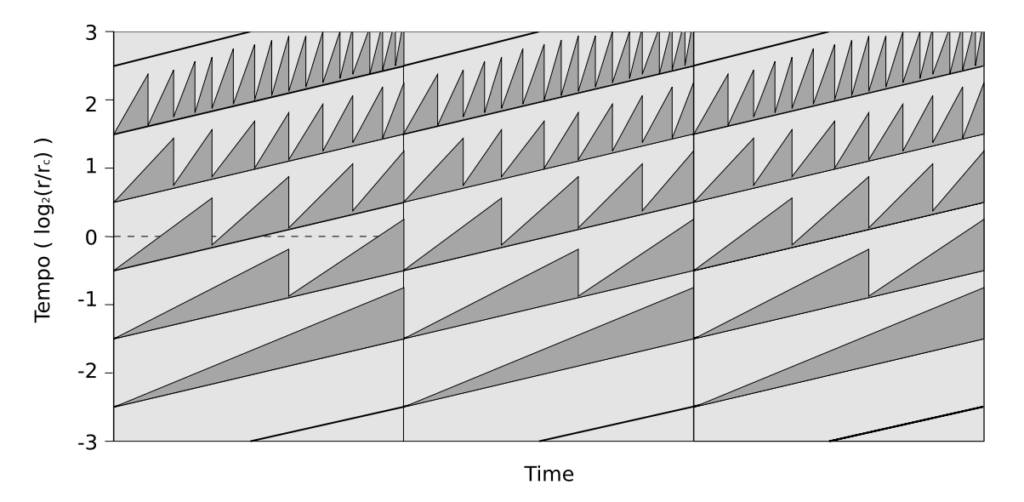
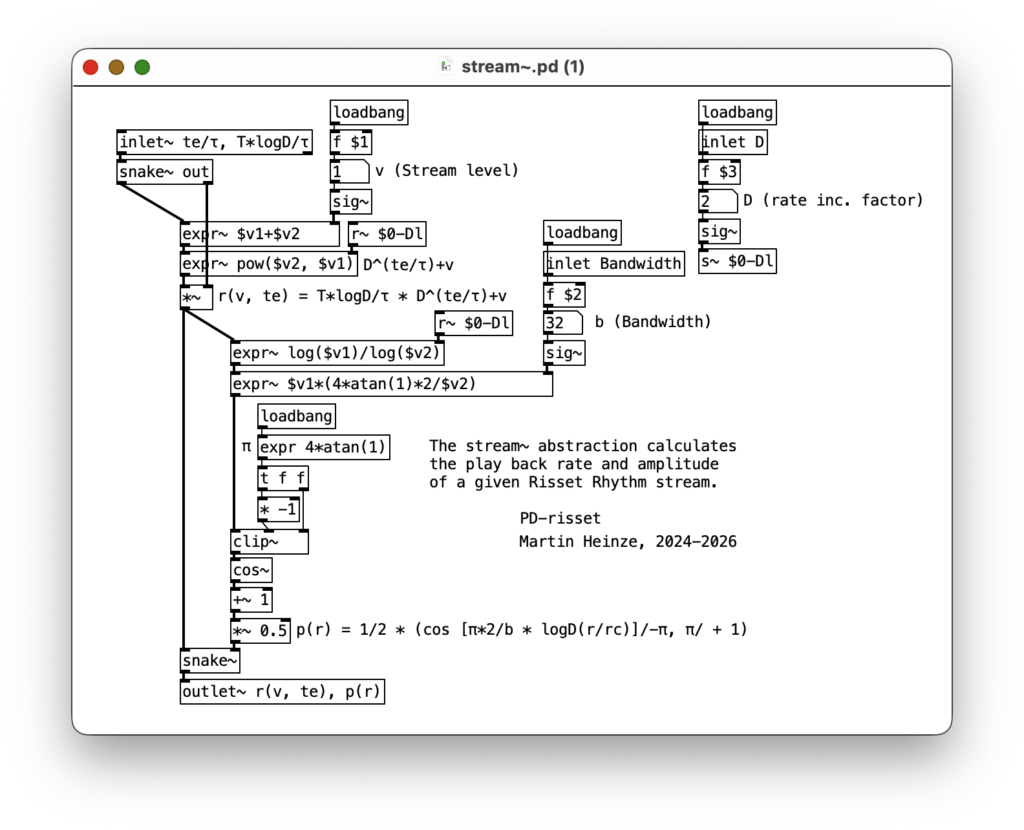
    In his 2011 paper “Scheduling and composing with Risset eternal accelerando rhythms”, Dan Stowell provided a solution for implementing eternal accelerandos on (rhythmic) audio samples by employing variable play back rates and amplitudes distributed to a number of sample play back streams that run synchronized.

    Illustration of Risset rhythm streams in Stowell, 2011

    Pure Data implementation

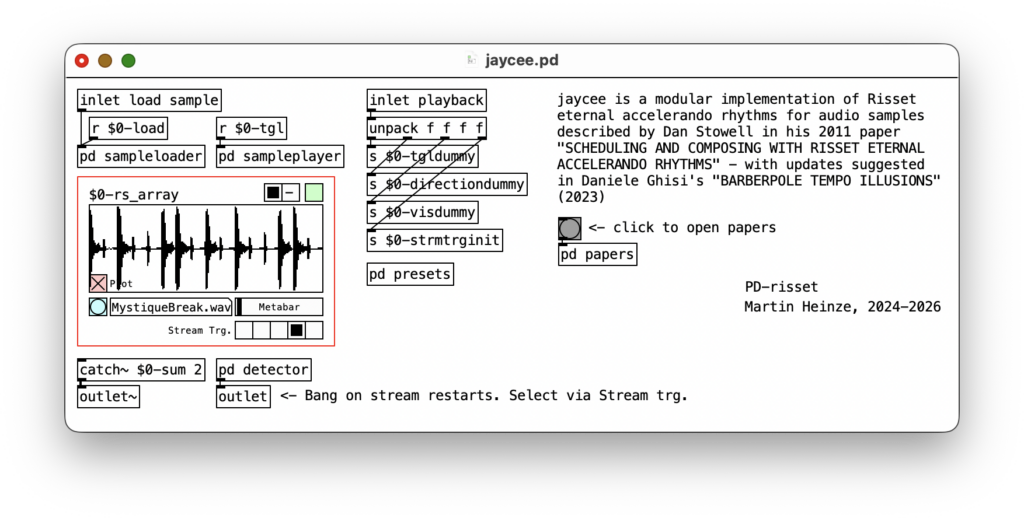
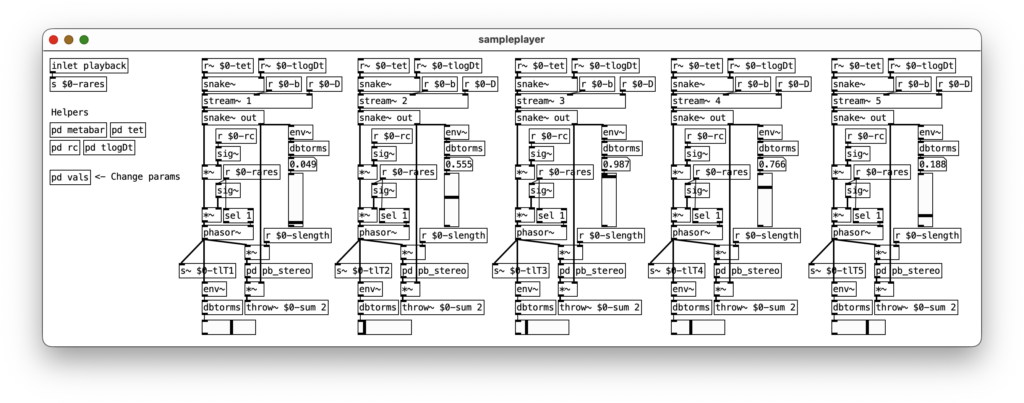
    Risset Sampler is a Pure Data implementation of an eternal accelerando I programmed following Stowell’s paper.

    The sampler has 5 streams set up to play back any given sample in a loop to generate the eternal accelerando effect. The individual play back rates and depending amplitude envelopes for each stream are calculated based on Stowell’s formulas (2) and (3).

    In addition to the stand alone risset_sampler.pd abstraction, i’ve also provided a modular version in the repo that can be embedded into larger compositions.

    Risset Remixes

    With the modular version of the Risset Sampler (jaycee.pd), I’ve done experiments on composition level which resulted in the Risset Remixes.

    MARTSM<>N – Risset Remixes [datamarts/2KOMMA2]: Bandcamp, Nina

    For these, I’ve been using stems from my tracks Axe Why Dread, Ting and Double Dub. In each composition, sample loops separated from these stems are being played back using the jaycee.pd abstraction.

    Events within the compositions are triggered by the completion of sub stream cycles in each sampler, creating a generative, closed circuit system. On the remix of Ting, manual triggers were also applied during recording. 

  • Saatgut Proxy

    Saatgut Proxy is an experimental generative setup in Pure Data that creates both randomized and repeatable pathways through the latent space of two neural audio model architectures (RAVE, vschaos2) at the same time.

    The framework is based both on generalized abstractions that I have developed for the Latent Jamming use case and additional prototypes of techniques that I turned into dedicated abstractions later on.

    Output examples

    The Saatgut Proxy framework led to the following release artifacts:

    MARTSM=N – VARIA 3L [datamarts/2KOMMA1]: Nina

    MARTSM))N – Saatgut Proxy Reflux [datamarts/2KOMMA0]: Nina

    MARTSM))N – Saatgut Proxy [n/a]: Bandcamp

  • Fibonacci Jungle

    While singular generative composition techniques have already become an established part of the creative process in music writing, holistic approaches to generative music production in traditional electronic dance music genres yet seem under-represented both in theory and practice.

    Fibonacci Jungle is a POC for a simple to use generative framework for Jungle and Drum & Bass built on the Fibonacci number sequence as structural alternative to conventional meters and track build-up.

    The framework is implemented in Pure Data. It uses probability and randomization within a pre defined set of genre typical parameter settings (tempo, harmonics, sample selection). Fibonacci Jungle allows creating stand alone tracks in a Jungle and Drum & Bass aesthetics with only a few clicks and can be individually customized.

    For a detailed description of concept and implementation, see this paper and the below presentation video from Generative Music Prize 2024, hosted by IRCAM, where Fibonacci Jungle was awarded 2nd place.

    The source code for Fibonacci Jungle is publicly available on GitHub.

    Output examples

    Fibonacci Jungle Versions – an EP of recordings based on the Fibonacci Jungle framework. Each track/ version has been recorded multiple times and individually distributed through different channels (BandcampNinaSpotify).

  • Spoor

    Early prototypes and tests setups in latent embedding mimickry and establishing a control level baseline in latent space have led to Spoor, both name of a loosely coupled set of Latent Jamming techniques and two releases:

    MARTSM/\N – Spoor Widen [datamarts/1KOMMA9]: Nina

    MARTSM/\N – Spoor [n/a]: Bandcamp

    Below video shows the setup that lead to tracks Loom and Loom Rewood.

    Track Architects was based on the following patch