Black Latents | Latent Diffusion is a gradio application that allows you to spawn audio items from Black Latents, a RAVE autoencoder trained on the Black Plastics series using RAVE-Latent Diffusion models.
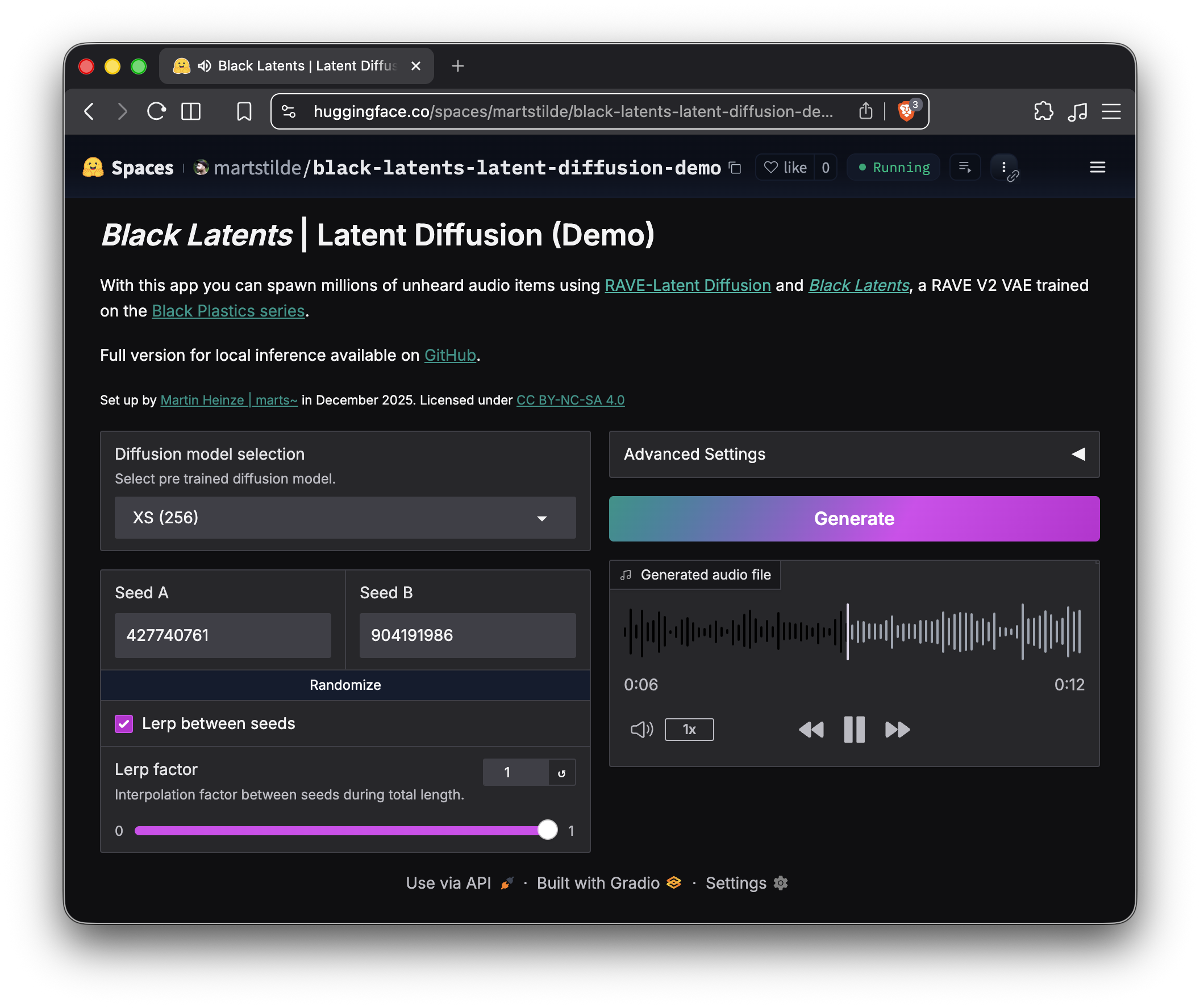
A demo version is accessible on Huggingface. The full application can be retrieved from GitHub to use in local inference.
Latent Diffusion with RAVE
RAVE is a variational autoencoder developed at IRCAM. Its main use case is timbre transfer on audio input, but you can also generate audio by using the autoencoder’s decoder as a neural audio synthesizer, as seen in Latent Jamming.
Another approach to use RAVE to spawn new audio information has been provided by Moisés Horta Valenzuela (aka 𝔥𝔢𝔵𝔬𝔯𝔠𝔦𝔰𝔪𝔬𝔰) with his RAVE-Latent Diffusion model.
This model operates on the highly compressed representations of the original data (latent embeddings). The key idea of RAVE-Latent Diffusion is to replicate structural coherency of audio information by encoding (longer) audio sequences into their latent representations using a RAVE encoder and then train a denoising diffusion model on these embeddings. The trained model is able to unconditionally generate new and similar sequences of the same length which can be decoded back into the audio domain using the RAVE model’s decoder.
The original package by 𝔥𝔢𝔵𝔬𝔯𝔠𝔦𝔰𝔪𝔬𝔰 supports a latent embedding length down to a window size of 2048, which translates to about 95 seconds of audio at 44.1 KHz, suitable for compositional level information.
In my fork RAVE-Latent Diffusion (Flex’ed), I extended the code to support a minimum of 256, which equals about 12 seconds at 44.1 KHz, and implemented a few other improvements and additional training options.
Black Latents: turning Black Plastics into a RAVE model
To train a RAVE-Latent Diffusion model and use it for audio generation, you need a RAVE autoencoder first. For this project, I used Black Latents, my contribution to the RAVE model challenge 2025 hosted by IRCAM.
The motivation to train Black Latents was to extract dominant characteristics from my Black Plastics series, a compilation of 7 EPs with a total of 28 audio tracks of genres Experimental Techno, Breakbeats and Drum & Bass, I released between 2012-2020.
Using Black Latents | Latent Diffusion to spawn audio
For Black Latents | Latent Diffusion, I trained diffusion models in 7 different configurations and context window lengths using once again the audio material from the Black Plastics series as base data set.
The application itself is a simple gradio interface to the generate script of RAVE-Latent Diffusion (Flex’ed). In the UI, you can choose from the different diffusion models, define seeds and set additional parameters like temperature or latent normalization before generating audio items through the Black Latents model decoder.
Depending on the diffusion model and parameter selection, the resulting output varies from stumbling rhythmic micro structures to items with resemblances of their base training data’s macro scale considerations.
Other examples
I published earlier experiments with RAVE-Latent Diffusion and a different set of RAVE models in the form of two albums:
MARTSMÆN – RLDG_0da02c80cb [datamarts/2KOMMA4]: Bandcamp, Nina
MARTSM^N – RLDG_835770db1c [datamarts/2KOMMA3]: Bandcamp, Nina