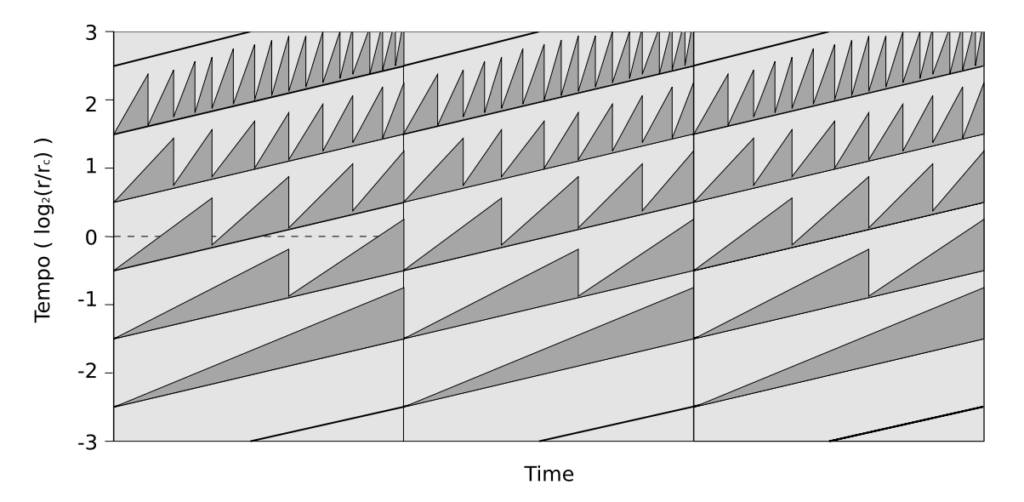
Jean-Claude Risset described the auditory illusion of an “eternal accelerando”, where, similar to Shepard tones for pitch, a rhythm can be structured and played back in a way that creates the perception of constant acceleration.
In his 2011 paper “Scheduling and composing with Risset eternal accelerando rhythms”, Dan Stowell provided a solution for implementing eternal accelerandos on (rhythmic) audio samples by employing variable play back rates and amplitudes distributed to a number of sample play back streams that run synchronized.
Daniele Ghisi updated and enhanced this approach in “Barberpole tempo illusions” (2023).
Pure Data implementation
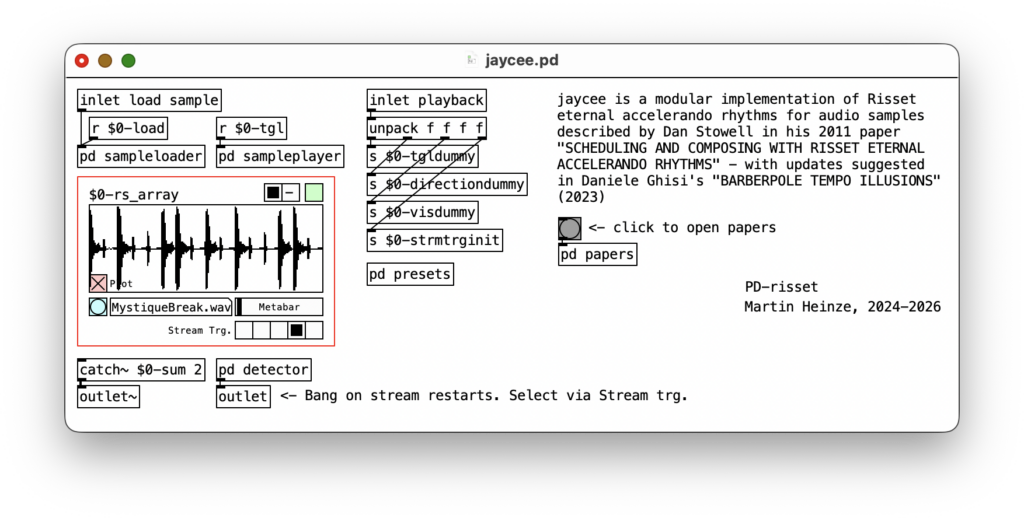
PD-risset is a Pure Data implementation of an eternal accelerando/ decelerando audio illusion I programmed following Stowell’s and Ghisi’s papers. The main component is jaycee.pd, a modular, stereo sample playback abstraction.
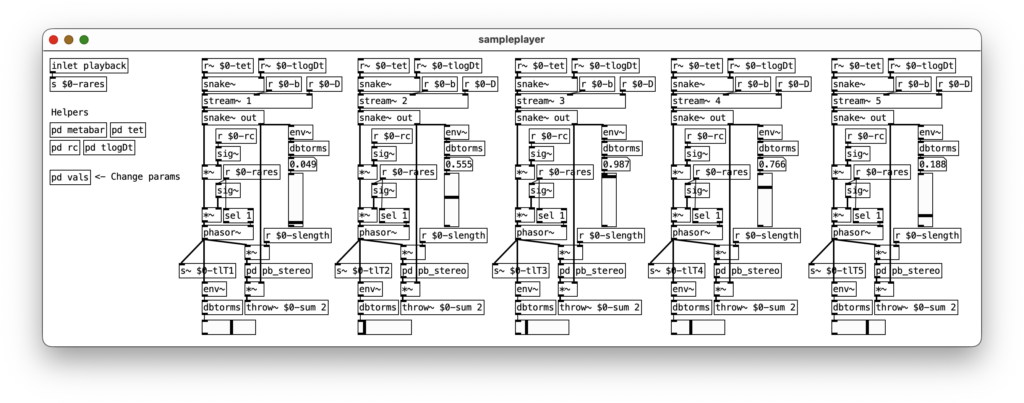
The abstraction contains the pd sampleplayer sub patch with 5 streams set up to play back a sample in different rates and amplitude to generate the eternal accelerando (or decelerando) effect.
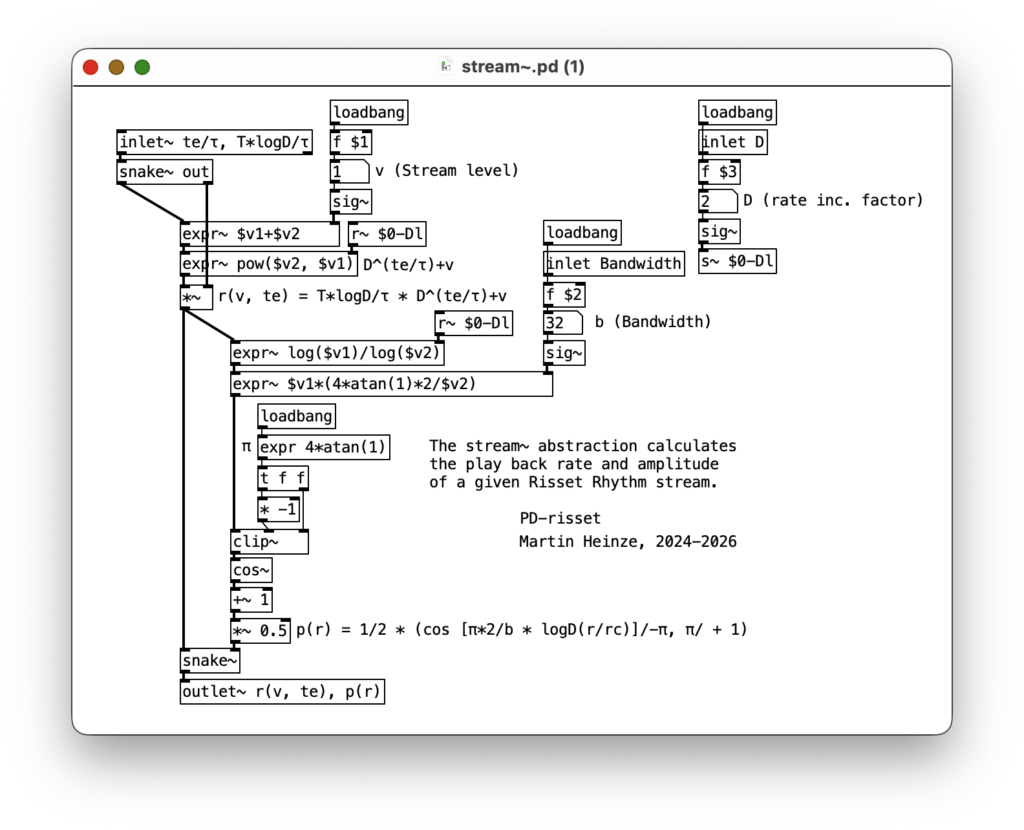
The individual play back rates and depending amplitude envelopes for each stream are calculated with Stowell’s formulas (2) and (3) in the stream~.pd abstractions. Ghisi suggested a correction to (3), which my implementation contains.
Examples
Three examples for Risset eternal accelerando rhythms from an earlier version of this implementation can be seen in the following video.
Risset Remixes
I’ve done experiments on composition level which resulted in the Risset Remixes.
For these, I’ve been using stems from my tracks Axe Why Dread, Ting and Double Dub. In each composition, sample loops separated from these stems are being played back using the jaycee.pd abstraction.
Events within the compositions are triggered by the completion of sub stream cycles in each sampler, creating a generative, closed circuit system. On the remix of Ting, manual triggers were also applied during recording.
Initially published in 2024, updated in June 2026